Explain it to me like I'm…High-school biology — proper terms explained
M1
Module 1 · The building blocks of life
The building blocks of life
Cells, chromosomesChromosomeA single, long DNA molecule packaged with histone proteins into a compact structure that can be seen under a microscope. Human body cells contain 46 chromosomes (23 pairs), each carrying hundreds to thousands of genes., and DNADNADouble-stranded molecule storing genetic information as A, T, G, C bases. structure: how genetic information is stored in the nucleus (Module 1).
Loading…
The central dogma
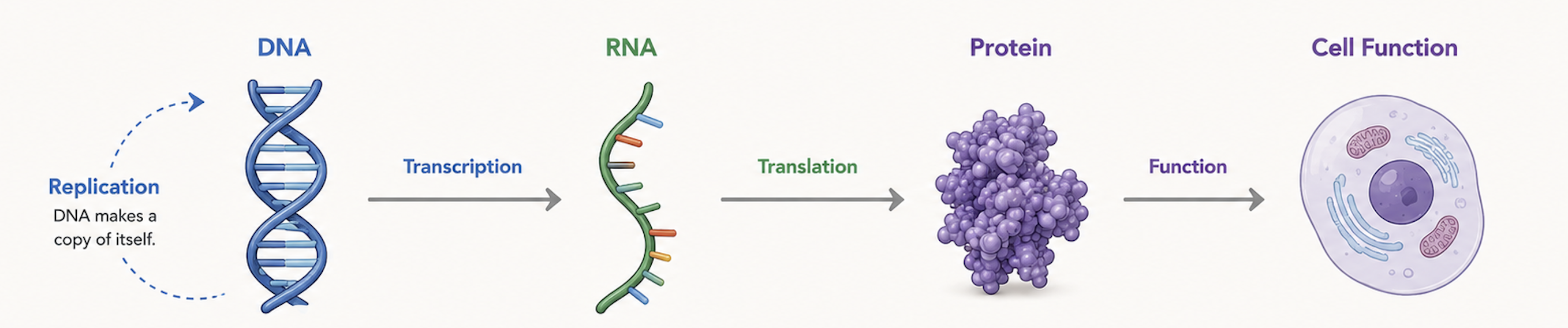
Genetic information, the instructions encoded in DNADNADouble-stranded molecule storing genetic information as A, T, G, C bases., generally flows in one main direction, from DNADNADouble-stranded molecule storing genetic information as A, T, G, C bases. to RNARNARibonucleic acid: usually single-stranded nucleic acid that uses uracil (U) instead of thymine (T). mRNA carries the protein-coding message from DNA. to proteinProteinA folded chain of amino acids that performs a specific function in the cell..
First, DNADNADouble-stranded molecule storing genetic information as A, T, G, C bases. stores the long-term instructions in the nucleus (the cell's control center). The first step, transcriptionTranscriptionMaking an RNA copy of a gene from a DNA template. (copying a geneGeneA stretch of DNA that codes for a functional product, usually a protein. into RNARNARibonucleic acid: usually single-stranded nucleic acid that uses uracil (U) instead of thymine (T). mRNA carries the protein-coding message from DNA.), creates a messenger RNAmRNAMessenger RNA: carries a gene's code from nucleus to ribosome. (mRNAmRNAMessenger RNA: carries a gene's code from nucleus to ribosome.) copy. That working copy can leave the nucleus and reach the machinery that builds proteinsProteinA folded chain of amino acids that performs a specific function in the cell..
Then translationTranslationAssembly of a protein at the ribosome using mRNA as instructions. reads mRNAmRNAMessenger RNA: carries a gene's code from nucleus to ribosome. in 3-base units called codonsCodonThree nucleotides in mRNA that code for one amino acid or a stop signal.. Each codonCodonThree nucleotides in mRNA that code for one amino acid or a stop signal. tells the cell which amino acidAmino acidMonomer with an amino group, carboxyl group, and unique side chain. to add next: a small building block that links into a proteinProteinA folded chain of amino acids that performs a specific function in the cell. chain. The cell links those amino acidsAmino acidMonomer with an amino group, carboxyl group, and unique side chain. into a chain, a proteinProteinA folded chain of amino acids that performs a specific function in the cell..
Think of it this way: DNADNADouble-stranded molecule storing genetic information as A, T, G, C bases. is the archive. RNARNARibonucleic acid: usually single-stranded nucleic acid that uses uracil (U) instead of thymine (T). mRNA carries the protein-coding message from DNA. is the working copy. The proteinProteinA folded chain of amino acids that performs a specific function in the cell. is the molecule that actually does the job.
1Replication
Before cell division, the double helix unzips and each strand serves as a template for building a new complementary strand, producing two identical DNA molecules.
2Transcription
RNA polymerase binds to the gene's promoter and reads the DNA template strand, building a complementary mRNA molecule that then travels out of the nucleus.
3Translation
The ribosome reads mRNA codons (triplets). Each codon is matched by a tRNA carrying the corresponding amino acid. Peptide bonds link the amino acids into a growing polypeptide chain.
4Cell Function
After translation, proteins fold into a 3D shape that determines their function — as enzymes, structural components, signalling molecules, or transporters. Amino acid sequence dictates the shape.
Why this matters for inheritance
A geneGeneA stretch of DNA that codes for a functional product, usually a protein. is a stretch of DNADNADouble-stranded molecule storing genetic information as A, T, G, C bases. sequence that encodes a functional product, usually a proteinProteinA folded chain of amino acids that performs a specific function in the cell..
Different allelesAlleleAlternative forms of a gene at the same spot on a chromosome. (variants of the same geneGeneA stretch of DNA that codes for a functional product, usually a protein.) differ by one or more bases. That can change the amino acidAmino acidMonomer with an amino group, carboxyl group, and unique side chain. sequence of the proteinProteinA folded chain of amino acids that performs a specific function in the cell.. In turn, that can change how the proteinProteinA folded chain of amino acids that performs a specific function in the cell. works.
This is the physical basis of hereditary traits. Eye color (often influenced by many genes), blood type, and many health conditions all trace back to which allelesAlleleAlternative forms of a gene at the same spot on a chromosome. you inherited, and how they affect the proteinsProteinA folded chain of amino acids that performs a specific function in the cell. your cells make.