Explain it to me like I'm…High-school biology — proper terms explained
M3
Module 3 · Passing it on
Passing it on
DNADNADouble-stranded molecule storing genetic information as A, T, G, C bases. replication, cell cycleCell cycleOrdered stages G1, S, G2, and M phase by which a cell grows and divides. & mitosisMitosisOne division producing two genetically identical diploid daughter cells., meiosisMeiosisCell division producing haploid gametes through two rounds of division., Mendelian inheritance, dominantDominantAllele expressed when at least one copy is present./recessiveRecessiveAllele expressed only when two copies are present.allelesAlleleAlternative forms of a gene at the same spot on a chromosome., and pedigree analysis. Module 3.
Loading…
Semi-conservative replication
Before a cell divides, DNADNADouble-stranded molecule storing genetic information as A, T, G, C bases. replication ensures that every daughter cell inherits a complete genome. It happens in S phaseS phaseSynthesis phase of interphase when the genome is replicated., the middle stage of interphaseInterphaseG1, S, and G2 stages between divisions; DNA is copied in S phase. in the cell cycleCell cycleOrdered stages G1, S, G2, and M phase by which a cell grows and divides. (between G1G1First interphase stage: cell growth before S phase replication. growth and G2G2Second interphase stage after replication; prepares for division. preparation; see the MitosisMitosisOne division producing two genetically identical diploid daughter cells. tab for the full cycle).
The double helixDouble helixThe twisted ladder structure of DNA formed by two antiparallel nucleotide strands wound around each other. unwinds and each strand serves as a template for building a complementary new strand, following the base-pairing rules: A pairs with T, and G pairs with C. This process is called semi-conservative replication: each resulting DNADNADouble-stranded molecule storing genetic information as A, T, G, C bases. molecule retains one parental strand paired with one newly synthesised strand.
Semi-conservative replication
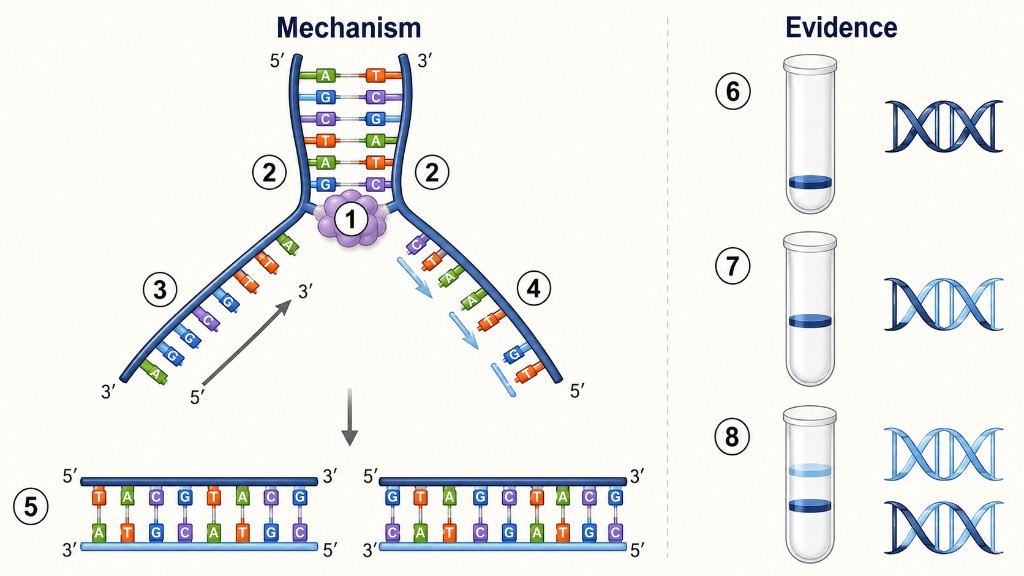
DNADNADouble-stranded molecule storing genetic information as A, T, G, C bases. replication is semi-conservative: each new double helixDouble helixThe twisted ladder structure of DNA formed by two antiparallel nucleotide strands wound around each other. keeps one parental strand and one new strand.
1Helicase
Helicase unwinds the duplex at the replication fork.
2Template strands
Parental strands serve as templates for complementary synthesis.
3Leading strand
The leading strand is synthesised continuously toward the fork (5′→3′).
4Lagging strand
The lagging strand is made as Okazaki fragments; ligase joins them.
5Semi-conservative products
Each daughter duplex contains one parental and one newly synthesised strand.
6¹⁵N-labelled DNA
DNADNADouble-stranded molecule storing genetic information as A, T, G, C bases. grown in ¹⁵NHaploidOne set of chromosomes (n); gametes are haploid. medium bands at heavy density in a centrifuge.
7Hybrid density
After one generation in ¹⁴NHaploidOne set of chromosomes (n); gametes are haploid., a single hybrid band supports semi-conservative replication.
8Hybrid + light
After two generations: 50% hybrid + 50% lightDNADNADouble-stranded molecule storing genetic information as A, T, G, C bases..
Enzymes of replication
A team of enzymes works at the replication fork: the Y-shaped opening where the two strands peel apart. Helicase unwinds the double helixDouble helixThe twisted ladder structure of DNA formed by two antiparallel nucleotide strands wound around each other.. Primase then lays down a short RNARNARibonucleic acid: usually single-stranded nucleic acid that uses uracil (U) instead of thymine (T). mRNA carries the protein-coding message from DNA. primer, because DNADNADouble-stranded molecule storing genetic information as A, T, G, C bases. polymerase cannot begin a new strand from nothing; it can only extend an existing one.
DNADNADouble-stranded molecule storing genetic information as A, T, G, C bases. polymerase builds in one direction only (5′→3′): the leading strand is built continuously towards the fork, while the lagging strand is built in short sections called Okazaki fragments going away from the fork. DNADNADouble-stranded molecule storing genetic information as A, T, G, C bases. ligase joins these fragments together. As it works, DNADNADouble-stranded molecule storing genetic information as A, T, G, C bases. polymerase also proofreads each newly added base, keeping replication errors extremely rare.