Explain it to me like I'm…High-school biology — proper terms explained
M2
Module 2 · Reading the code
Reading the code
TranscriptionTranscriptionMaking an RNA copy of a gene from a DNA template., translationTranslationAssembly of a protein at the ribosome using mRNA as instructions., and the genetic codeGenetic codeThe set of rules mapping each mRNA codon to a specific amino acid or stop signal. It is nearly universal across life.: how sequence becomes function. Module 2.
Loading…
Recap: the central dogma
The central dogma
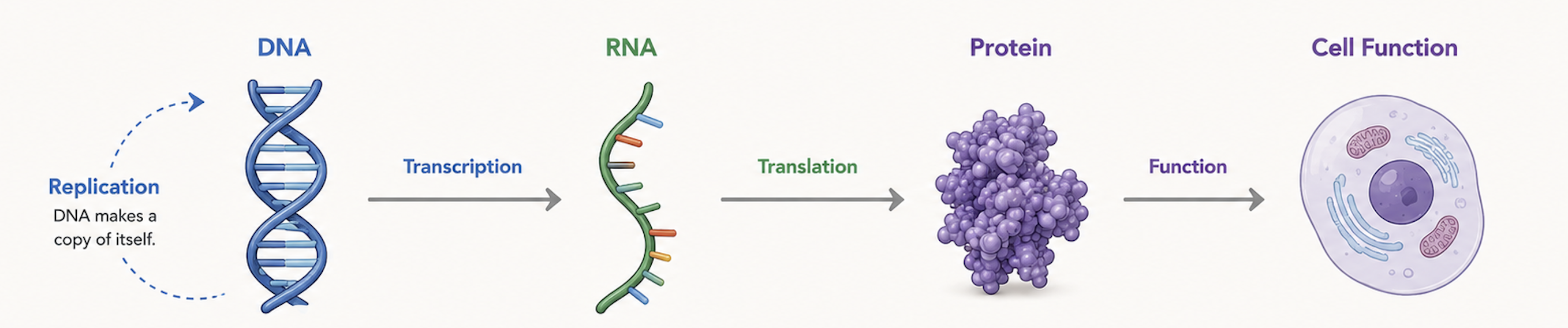
Genetic information, the instructions encoded in DNADNADouble-stranded molecule storing genetic information as A, T, G, C bases., generally flows in one main direction, from DNADNADouble-stranded molecule storing genetic information as A, T, G, C bases. to RNARNARibonucleic acid: usually single-stranded nucleic acid that uses uracil (U) instead of thymine (T). mRNA carries the protein-coding message from DNA. to proteinProteinA folded chain of amino acids that performs a specific function in the cell..
First, DNADNADouble-stranded molecule storing genetic information as A, T, G, C bases. stores the long-term instructions in the nucleus (the cell's control center). The first step, transcriptionTranscriptionMaking an RNA copy of a gene from a DNA template. (copying a geneGeneA stretch of DNA that codes for a functional product, usually a protein. into RNARNARibonucleic acid: usually single-stranded nucleic acid that uses uracil (U) instead of thymine (T). mRNA carries the protein-coding message from DNA.), creates a messenger RNAmRNAMessenger RNA: carries a gene's code from nucleus to ribosome. (mRNAmRNAMessenger RNA: carries a gene's code from nucleus to ribosome.) copy. That working copy can leave the nucleus and reach the machinery that builds proteinsProteinA folded chain of amino acids that performs a specific function in the cell..
Then translationTranslationAssembly of a protein at the ribosome using mRNA as instructions. reads mRNAmRNAMessenger RNA: carries a gene's code from nucleus to ribosome. in 3-base units called codonsCodonThree nucleotides in mRNA that code for one amino acid or a stop signal.. Each codonCodonThree nucleotides in mRNA that code for one amino acid or a stop signal. tells the cell which amino acidAmino acidMonomer with an amino group, carboxyl group, and unique side chain. to add next: a small building block that links into a proteinProteinA folded chain of amino acids that performs a specific function in the cell. chain. The cell links those amino acidsAmino acidMonomer with an amino group, carboxyl group, and unique side chain. into a chain, a proteinProteinA folded chain of amino acids that performs a specific function in the cell..
Think of it this way: DNADNADouble-stranded molecule storing genetic information as A, T, G, C bases. is the archive. RNARNARibonucleic acid: usually single-stranded nucleic acid that uses uracil (U) instead of thymine (T). mRNA carries the protein-coding message from DNA. is the working copy. The proteinProteinA folded chain of amino acids that performs a specific function in the cell. is the molecule that actually does the job.
1Replication
Before cell division, the double helix unzips and each strand serves as a template for building a new complementary strand, producing two identical DNA molecules.
2Transcription
RNA polymerase binds to the gene's promoter and reads the DNA template strand, building a complementary mRNA molecule that then travels out of the nucleus.
3Translation
The ribosome reads mRNA codons (triplets). Each codon is matched by a tRNA carrying the corresponding amino acid. Peptide bonds link the amino acids into a growing polypeptide chain.
4Cell Function
After translation, proteins fold into a 3D shape that determines their function — as enzymes, structural components, signalling molecules, or transporters. Amino acid sequence dictates the shape.
Transcription: DNA to RNA
Before translationTranslationAssembly of a protein at the ribosome using mRNA as instructions. can happen, the cell makes a working RNARNARibonucleic acid: usually single-stranded nucleic acid that uses uracil (U) instead of thymine (T). mRNA carries the protein-coding message from DNA. copy of a single geneGeneA stretch of DNA that codes for a functional product, usually a protein., a process called transcriptionTranscriptionMaking an RNA copy of a gene from a DNA template.. TranscriptionTranscriptionMaking an RNA copy of a gene from a DNA template. takes place in the nucleus, where the DNADNADouble-stranded molecule storing genetic information as A, T, G, C bases. is stored, and produces messenger RNAmRNAMessenger RNA: carries a gene's code from nucleus to ribosome. (mRNAmRNAMessenger RNA: carries a gene's code from nucleus to ribosome.): a portable copy the cell can send out to the proteinProteinA folded chain of amino acids that performs a specific function in the cell.-building machinery.
The enzyme RNARNARibonucleic acid: usually single-stranded nucleic acid that uses uracil (U) instead of thymine (T). mRNA carries the protein-coding message from DNA. polymerase II (the version that transcribes proteinProteinA folded chain of amino acids that performs a specific function in the cell.-coding genes) binds to a promoter (a start signal just before the geneGeneA stretch of DNA that codes for a functional product, usually a protein.), unwinds a short stretch of the double helixDouble helixThe twisted ladder structure of DNA formed by two antiparallel nucleotide strands wound around each other., and reads the template strand. It builds a new RNARNARibonucleic acid: usually single-stranded nucleic acid that uses uracil (U) instead of thymine (T). mRNA carries the protein-coding message from DNA. strand using the same base-pairing rules as DNADNADouble-stranded molecule storing genetic information as A, T, G, C bases., except uracil (U) takes the place of thymine (T), pairing with adenine.
Processing the message: pre-mRNA to mRNA
The first RNARNARibonucleic acid: usually single-stranded nucleic acid that uses uracil (U) instead of thymine (T). mRNA carries the protein-coding message from DNA. copy, called pre-mRNAmRNAMessenger RNA: carries a gene's code from nucleus to ribosome., is not yet ready for translationTranslationAssembly of a protein at the ribosome using mRNA as instructions.. Inside the nucleus, it goes through RNARNARibonucleic acid: usually single-stranded nucleic acid that uses uracil (U) instead of thymine (T). mRNA carries the protein-coding message from DNA. processing: a protective 5′ cap is added at the front, a poly-A tail (a long string of adenine bases) is added at the back, and non-coding sections called introns are cut out by a complex called the spliceosome, leaving the remaining exons joined together (most of this becomes proteinProteinA folded chain of amino acids that performs a specific function in the cell.-coding sequence, though the very ends of the mRNAmRNAMessenger RNA: carries a gene's code from nucleus to ribosome. stay untranslated).
The finished, mature mRNAmRNAMessenger RNA: carries a gene's code from nucleus to ribosome. then exits the nucleus through nuclear pores and travels to a ribosomeRibosomeCell structure that reads mRNA and links amino acids into proteins., where translationTranslationAssembly of a protein at the ribosome using mRNA as instructions. takes over.